Welcome to
benjaminhoffauthor.com
The only official website –- and, in all probability, the only factually correct website –- for the author Benjamin Hoff.
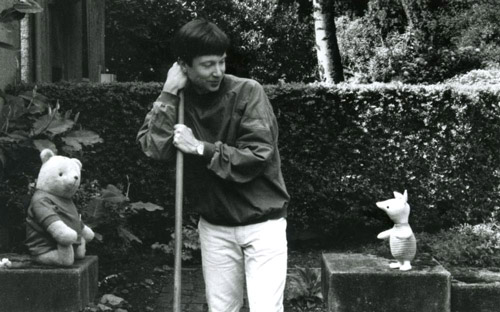 Benjamin Hoff is the author
of The Tao of Pooh and The Te of Piglet, both of which
explain the Chinese philosophy of Taoism through the characters created by A.A. Milne, and The Singing Creek Where the Willows
Grow, his biography of fellow Oregon author and charismatic nature teacher Opal Whiteley. All three books were Book-of-the-Month Club
selections. The Tao of Pooh and The Te of Piglet were also selections of the
Quality Paperback Book Club.
Benjamin Hoff is the author
of The Tao of Pooh and The Te of Piglet, both of which
explain the Chinese philosophy of Taoism through the characters created by A.A. Milne, and The Singing Creek Where the Willows
Grow, his biography of fellow Oregon author and charismatic nature teacher Opal Whiteley. All three books were Book-of-the-Month Club
selections. The Tao of Pooh and The Te of Piglet were also selections of the
Quality Paperback Book Club.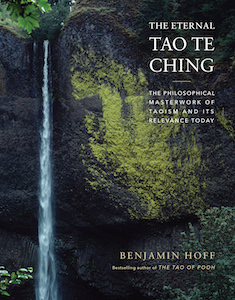
From Benjamin Hoff, author of The Tao of Pooh and The Te of Piglet, which have sold millions of copies worldwide, comes The Eternal Tao Te Ching (Abrams; December 7, 2021; US $24.99; Hardcover), a new translation of the Chinese philosophical classic, the Tao Te Ching.
The Eternal Tao Te Ching is the first translation to employ the meanings of the pre-writing brush characters in use 2,400 years ago, when the classic was written, rather than relying on the often-different meanings of the more modern brush characters, as other translations have done. Hoff points out in his chapter notes the many incidents of meddling and muddling that have been made over the centuries by scholars and copyists, and he corrects the mistakes and removes such tampering from the text. He also makes the provocative claim—and demonstrates by revealing clues in the text—that the Tao Te Ching’s author was a young nobleman hiding his identity, rather than the long-alleged author, the “Old Master” of legend, Lao-tzu. And his chapter notes shed new light on the author’s surprisingly modern viewpoint. With a selection of Benjamin Hoff’s lyrical color landscape photographs, this is a unique, and uniquely accessible, presentation of the Tao Te Ching.
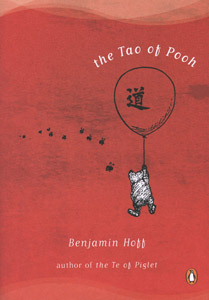
The Tao of Pooh –- an international bestseller and the first Taoist-authored book in history to appear on bestseller lists –- was on The New York Times’ bestseller list for 49 weeks. Its international-bestseller successor, The Te of Piglet, was on New York Times for 59 weeks.
Both books brought the previously obscure philosophy of Taoism to the attention of mainstream America. (For a couple of examples of how mainstream: The Tao of Pooh was the subject of a question in a TV Guide crossword puzzle; The Te of Piglet was the subject of a question on the television show “Jeopardy.”)
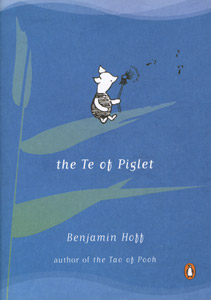
For years they have been used as high school and college texts for classes in a wide variety of subjects, including science, business, philosophy, literature, and world culture.
They have been publicly endorsed by notables such as English pop-philosophy author John Tyerman Williams, American marketing communication guru Michael Ray, Wall Street investment counselor and author Bennet Goodspeed, and popular screen actress Julia Roberts.

The Singing Creek Where the Willows Grow, the book most often credited with the current worldwide interest in Opal Whiteley, won an American Book Award. It is the only book on Opal Whiteley popularly acknowledged as a “cult classic.”
In 2010, as part of the publisher’s 75th anniversary celebration, Penguin Books selected The Tao of Pooh to be one of the 75 books featured in the house’s printed promotion and public displays.
The descendant of two family lines of artists, engineers, and explorers, Benjamin Hoff has been a writer, an investigative photojournalist, a tree pruner, a songwriter, and a recording musician and singer. He has studied architecture, music, fine arts, graphic design, and Asian culture –- including Japanese Tea Ceremony (third certificate level), Japanese fine-pruning methods (two years of apprenticeship), and the comparatively esoteric martial-art form of T’ai Chi Ch’uan (four years of instruction, including a year of Ch’i Kung).
He attended Sylvan School, West Sylvan Middle School, Benson Polytechnic, Lincoln High School (the latter two in Portland), the University of Oregon in Eugene, the Museum Art School (now the Pacific Northwest College of Art) in Portland, and The Evergreen State College in Olympia, Washington, from which he graduated with a B.A. degree.
From his father –- a scholar and collector of Asian art, and a close friend of the landscape painter Chiura Obata –- he gained a familiarity with and a love of Eastern ways; from his mother’s English/Irish/Welsh family background, he gained a familiarity with and a love of British literature and culture. These East/West influences eventually came together in the writing of The Tao of Pooh and The Te of Piglet.
Benjamin Hoff enjoys playing classical guitar, composing music, photographing nature, and “improving things.” At present, he is designing a line of revolutionary solidbody electric guitars and speaker cabinets.
Benjamin Hoff is listed in Who’s Who in America, and is one of only 55,000 individuals selected from the populations of 215 nations and territories to be listed in Who’s Who in the World.
In April 2018 he was awarded the 2018 Albert Nelson Marquis Lifetime Achievement Award. This award is bestowed upon less than 5% of Marquis Who's Who biographical listees.
Benjamin Hoff has not authorized any e-book editions of these books: The Tao of Pooh, The Te of Piglet, The Singing Creek Where the Willows Grow. Any company or organization that states or implies that it has his authorization for its e-book editions of his work is lying as well as stealing. Anyone purchasing or downloading any e-book editions of these books is violating the author’s rights.
February 14, 2024: I have decided to post an address here that readers of my books can send mail to. It can also serve to receive contributions that anyone might care to send to help me take legal action against Penguin and Abrams for my debilitating depression caused by years of their excessively autocratic behavior, including their complete retention of reader and professional mail addressed to me.
Until further notice to the contrary, my mailing address will be:
Benjamin Hoff
PO Box 38
Wilsonville, OR 97070
Due to an expensive divorce, rising costs for rent and other necessities, and years of publishers' rejection of my post-Pooh manuscripts (which, as some of those people remarked or strongly implied, they wouldn't publish because the manuscripts weren't about Winnie-the-Pooh), it's all I can do to pay for essential services -- and I can only manage to do that by repeatedly withdrawing money from what little is left of my retirement funds. It's clear to me by now that without legal representation, I will never be granted access to my reader or professional mail or compensated for the years of crippling emotional stress that those two publishers above all have put me through.
ENOUGH IS ENOUGH
August 22, 2023: It has now been nearly a year and ninge months since The Eternal Tao Te Ching appeared in bookstores and on the Internet. Yet | have not received any forwarded reader or professional mail from anyone anywhere in the world addressed to me in care of its publisher. Whenever I've voiced concern about the complete absence of forwarded mail, I've been reminded by Abrams that the mailroom staff were told to look out for any mail with my name on it and to deal with it immediately. And | have been repeatedly reminded by them that one letter for me did arrive last year, and was forwarded to me -- the implication being that the author mail system is working, so | have nothing to be concerned about.
The letter in question, postmarked April 29, 2022, was addressed to one of the production people listed on the back page of the book, in care of Harry N. Abrams, Inc. Inside its envelope was a note from a former employer of mine explaining that he didn't have a current address for me, and asking the individual to whom he'd sent it to forward the letter enclosed to me. She promptly did so, and phoned to tell me about it. She included with the letter a photocopy of its envelope. My name is not on it, only her name and the publisher's name and address.
Spending six-and-a-half difficult years researching for and writing a uniquely accurate and understandable translation of the Tao Te Ching, the greatest (and most misunderstood) classic of long-popular Taoist philosophy, and then receiving only one response following its publication would be enough to drive any writer into a state of deep depression. At least, that's what its done to me.
There has not been, and there apparently will never be, the mail search | requested from Abrams. | was subjected to a similar behavior pattern of denial, dismissal, and indifference on the part of Penguin, the publisher. of three of my books, which for years has not forwarded to me even one item of reader or professional mail.
When | wrote my first manuscript decades ago, | imagined publishers to be business-like but human. Yet in my experience with six of them over the years (Warner Books, Minotaur, Harper Audio, Dutton, Penguin, and Abrams) I've found them to be cold-blooded, arrogant, and mean. Their dishonest and obstructionist behavior has by now made it necessary for my health to discontinue my life as an author. I'd wanted to be an author since the first time | stepped up into the Bookmobile that visited the small grammar school | attended in Sylvan, Oregon. | have no desire or incentive to continue my life as anything else. But I've finally had to admit to myself that I'm tired of attempting to deal with publishers, tired of being made to feel miserable.
| wrote the manuscripts I've written, some of which have been published, in the hope that they might bring some light to our ever-darkening world. In return, I've been treated by their publishers like a naughty, stupid child. After decades of that treatment, I'm not willing to try my luck with one more publisher. Enough is enough.
B.H.
August 28, 2022
Whichever editor is now in charge
of The Eternal Tao Te Ching
Abrams Books
195 Broadway New York, NY 10007
To Whom It May Concern:
Enclosed is a list of typos I found in the first printing of my The Eternal Tao Te Ching after I'd passed the first list along, some time ago. I don't know if the book has gone beyond a first printing. Thanks to Abrams, I've lost all interest in it. But I'm enclosing the list because I don't feel right about leaving typographical errors uncorrected.
I have not received a copy of the audio edition of the book, which I assume has by now been released, and which I believe I'm supposed to be given a copy of. Nor have I received the first (March) royalty statement promised in the author/publisher contract. I hope that someone can make sure that I'm sent the second one, which the contract says is due in September.
To those who have for some unfathomable reason worked to ensure that not even one item of my reader or professional mail has been forwarded to me in the nine months following the book's release: Congratulations. You've done your best to destroy my career and ruin my life, and are succeeding on both fronts. But remember: Mail theft is a Federal offense. And sooner or later, you'll be held accountable for your actions.
This letter will likely be my last attempt to communicate to anyone at Abrams.
Yours truly,
Benjamin Hoff
April 15, 2022
Michael Jacobs
Chief Executive Officer
Abrams Books
195 Broadway
New York, NY 10007
Dear Michael:
I've finally decided to write to you about a problem that has not been resolved, despite my repeatedly expressed concerns about it. I'll be as brief as I can, but I believe that some background needs to be given here:
Forty years ago, The Tao of Pooh was published by Dutton. Although it nearly died in hardcover due to the new owner's near-freeze on promotion spending, when it was released in paperback by Penguin it made it onto the New York Times bestseller list, thanks to a review in the Washington Post and a mention on National Public radio (arranged by Penguin), as well as to growing word-of-mouth public interest. Since then, it has sold millions of copies worldwide, has been translated into thirty-four languages, and has been endorsed by celebrities such as Meghan Markle and Julia Roberts. Ten years after its publication, The Te of Piglet was released and achieved similar success. And in 1995, Penguin published The Singing Creek Where the Willows Grow, which included my biography of 1920s bestselling author Opal Whiteley, which is still in print.
Yet one December over ten years ago, reader and professional mail forwarded to me by Penguin stopped. Since then, I have received no more forwarded reader letters, copies of my books to sign and mail back, books from authors who asked me to write endorsements that they could use for promotion, books that readers thought I would enjoy, complete or partial manuscripts sent by their authors who asked me to recommend publishers or editors to them, communications from speakers' bureaus, requests from literary, social, and environmental organizations for me to appear at book fairs or sign books to be auctioned or sold to support this-or-that cause... Not one item of mail.
Since then, whenever I've voiced my concerns to various people at Penguin about that complete absence of forwarded mail, the response has been: "If you're not receiving any mail, it's because no one is writing to you. When any such mail comes in, we'll be sure to forward it." No one at Penguin has agreed to conduct an on-premises physical search for my mail, even when I've pointed out that it's impossible to have readers around the world yet no longer receive even one item of mail from any of them. And now the total-absence-of-forwarded-mail phenomenon seems to be happening at Abrams regarding The Eternal Tao Te Ching.
Two or three weeks before the book's official release date of December 7 of last year, I had my website-builder put on benjaminhoffauthor.com an announcement of its upcoming release, a description of it, and a list of outlets to order it from. At the time, I thought that those who had read my website warnings about Penguin's apparent halt to mail-forwarding could send their letters, etc. to me in care of Abrams Books. But:
It's now been more than five months since the website announcement about The Eternal Tao Te Ching was posted, yet I have received no forwarded mail from anyone. Even if by now the book had sold only 200 copies, I would -- applying common-sense reasoning and knowledge gained in forty years of experience -- expect to have received something.
It's not only old and new readers of my books that I have not received forwarded mail from. I have received no written response from people I asked Abrams to send copies of the book to -- people who would not have my home address or phone number -- including Dr. Yi Wu, the San Francisco author and scholar to whom I dedicated The Eternal Tao Te Ching. I have to consider the possible public-relations problems that can result from my not answering any of my readers' mail.
I feel obligated to readers of my books to have a notice put on my website about this second non-forwarding-of-mail situation.
On May 7, unless someone at Abrams conducts a sincere and thorough physical search for mail addressed to me in care of Abrams Books, I will have my website builder put on such a notice.
Yours truly, Benjamin Hoff
As of August 1, 2022, I have received no response -- and no forwarded mail. B.H.
I have received no communication from anyone at Abrams since an April 13 letter from the publishing house arrived informing me that:
- The Eternal Tao Te Ching was being sold in the U.S., its territories and possessions, Canada, the U.K., Ireland, Australia, Denmark, Sweden, France, Germany, Hungary, Romania, and Mauritius, and would soon be sold in South Africa as well.
- Abrams was going to be selling the book to wholesalers that distribute to a variety of other nations.
- As I had already been told on two or three occasions, no reader or professional mail addressed to me had arrived at the publisher.
One might wonder how, considering the information given in the first statement, the conclusion given in the third statement could have been reached -- and why any author would be expected to rely on it. B.H.
April 20, 2018
The Trustees of the Pooh Properties
c/o Ms. Stephanie Thwaites
Curtis Brown
Haymarket House
28-29 Haymarket
London SW1Y 4SP England
U.K.
To Whom it May Concern:
Thanks to a provision of revised U.S. copyright law, I will be recapturing the U.S. copyright for The Tao of Pooh as of December 15 of this year. I thought it best to inform the Trustees and Curtis Brown as to why I'm taking this action, so there will be -- I hope -- no misunderstanding.
Penguin's proposed contract for renewing their right to publish, the terms of which they claim are the best they can manage, seems to me a "We're taking it all this time around" agreement. But I am more substantially concerned with their long-standing and consistently disrespectful and uncaring treatment of the book's author -- a "We're not going to do you any favors" attitude that seems especially inappropriate when directed toward an author whose books have earned their corporation millions of dollars not because of expensive promotion but primarily by word-of-mouth. I believe the following three examples of Penguin's author-treatment will be enough to make the point, although I could supply many more:
(1) When Penguin chose The Tao of Pooh to be one of the 75 books representing the publisher for their seventy-fifth-year anniversary celebration, I received no congratulatory letter informing me that the book had been chosen. Nor did I receive any of the memorabilia (poster, etc.) made for the celebration's public displays and press releases. When I read or heard about the events, I wrote to Penguin asking for a poster. I was sent a vinyl shopping bag -- the only thing, I was told, that had been left over.
(2) Over the years I have requested from various people at Penguin a list of the books and magazines that have quoted from The Tao of Pooh -- which I've been told is one of the most-quoted-from books in recent times. The response each time is that to grant my request would be "too much bother."
(3) For a quarter-century -- since 1993, when The Tao of Pooh and The Te of Piglet were simultaneously on The New York Times' bestseller list, for which I was listed in the American Booksellers Association newsletter in 1994 as one of the top-selling paperback authors of the year, yet received a suspiciously small amount of forwarded reader and professional mail (requests for public appearances at book-signings or other events) -- I have voiced my concerns about what others in the book-business have told me is an impossibly small quantity of mail. For six years and three months now I have received no forwarded mail whatever -- no reader-letters, no books to sign or endorse, no requests for public appearances, etc. When I placed a notice to that effect on my website, along with a Post Office box address at which website-readers could reach me, I received more mail in the year or so of the notice than I had received for many years by way of Penguin. Some readers wrote to me at the P.O. box saying that they had sent copies of their letters to me in care of Penguin so that I could see if they were forwarded to me. Not one of the letter-copies arrived at my home address, forwarded to me by Penguin. Over the years I have asked various people at Penguin to make a thorough physical search for my missing mail, g oing beyond the mailroom if possible. Each time my request was dismissed. At first, when I was receiving some mail, I was told, "If you're not receiving much mail, it means not many people are writing to you." When I later pointed out (over six years ago) that I was not receiving any forwarded mail, I was told, "That's because no one is writing to you." Tao of Pooh book sales for the U.S. and beyond are such that only an idiot would believe such a statement. But an idiot is evidently what these people take me for.
I have endured enough incidents of mean-spirited treatment including the above during my 36 years with Dutton-then-Penguin to convince me that I must now go elsewhere. That, in summary, is my explanation.
Yours Truly,
Benjamin Hoff
P.S. A few days ago I received a letter from Marquis Publications, publisher of Who's Who in America and Who's Who in the World (in both of which I'm listed), saying in part: "I am pleased to announce that you are being considered for the 2018 Albert Nelson Marquis Lifetime Achievement Award.... The Lifetime Achievement Award is bestowed upon less than 5% of Marquis biographical listees."
According to USPS Tracking, the above letter was delivered on April 25. As of June 15, I have received no reply.
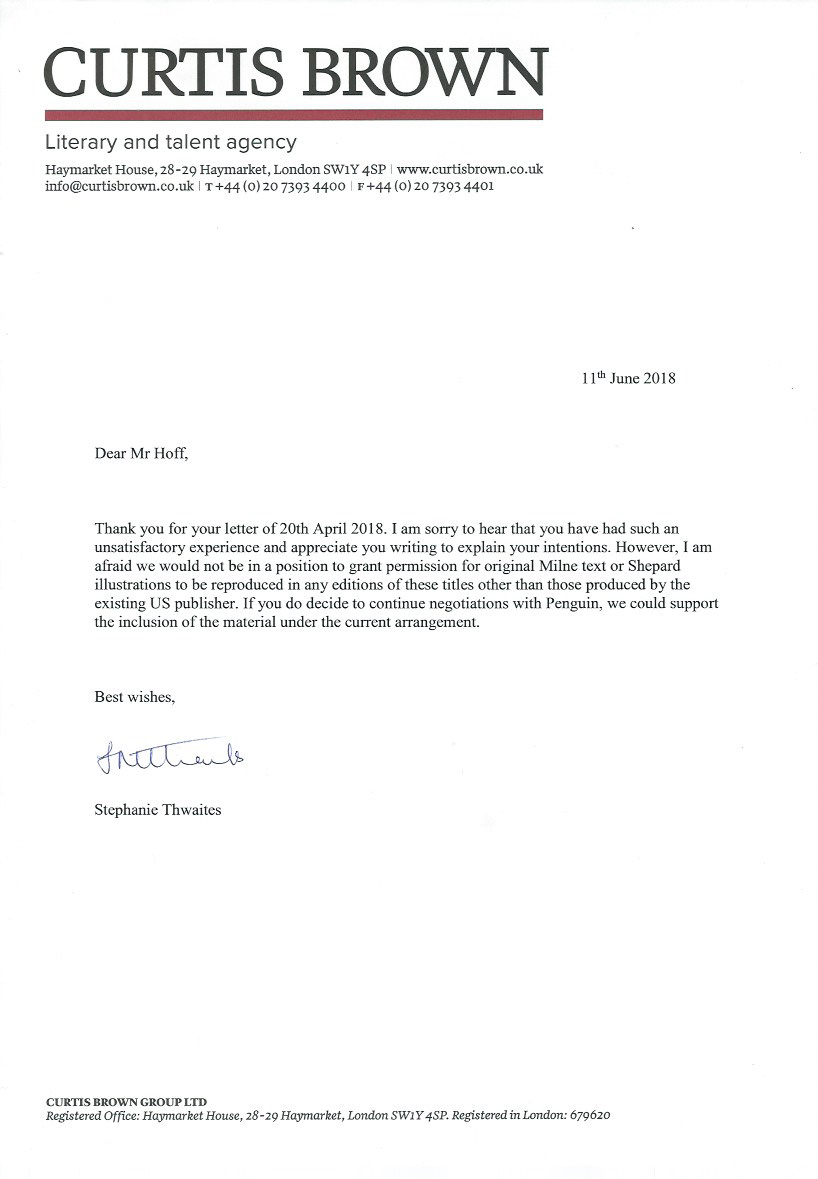
June 20, 2018
Dear Ms. Thwaites:
Regarding your just-received reply of June 11 to my letter of April 20:
In that case, as of December 15 there will be no U.S. publication of The Tao of Pooh. I will not prolong an abusive relationship with a publisher that continues to treat me with contempt.
Yours truly,
Benjamin Hoff
As of August 20th, I have received no reply.
The Trustees of the Pooh Properties -- who, it would seem, have no interest in granting me the right to take The Tao of Pooh to a more appreciative publisher -- will lose their permissions-fees payments of 40% of my Penguin U.S. paperback royalties and 33 1/3% of my Penguin U.S. hardcover royalties starting on December 15, when the Penguin U.S. editions become illegal.
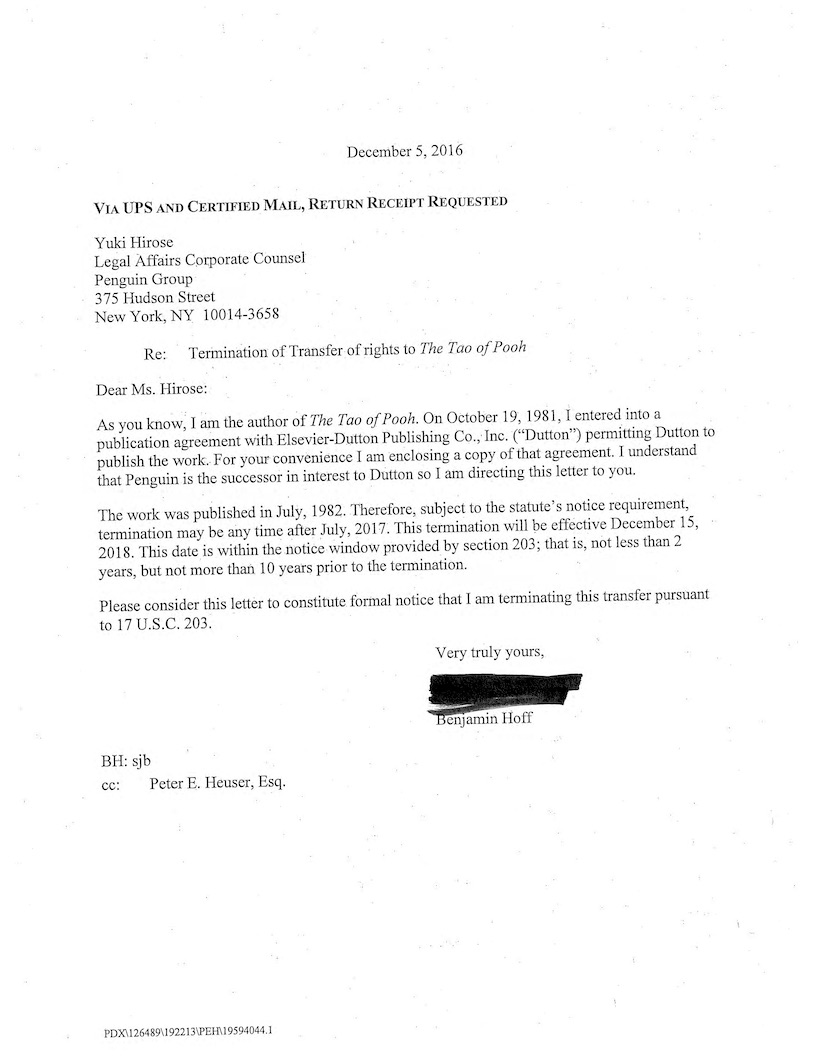
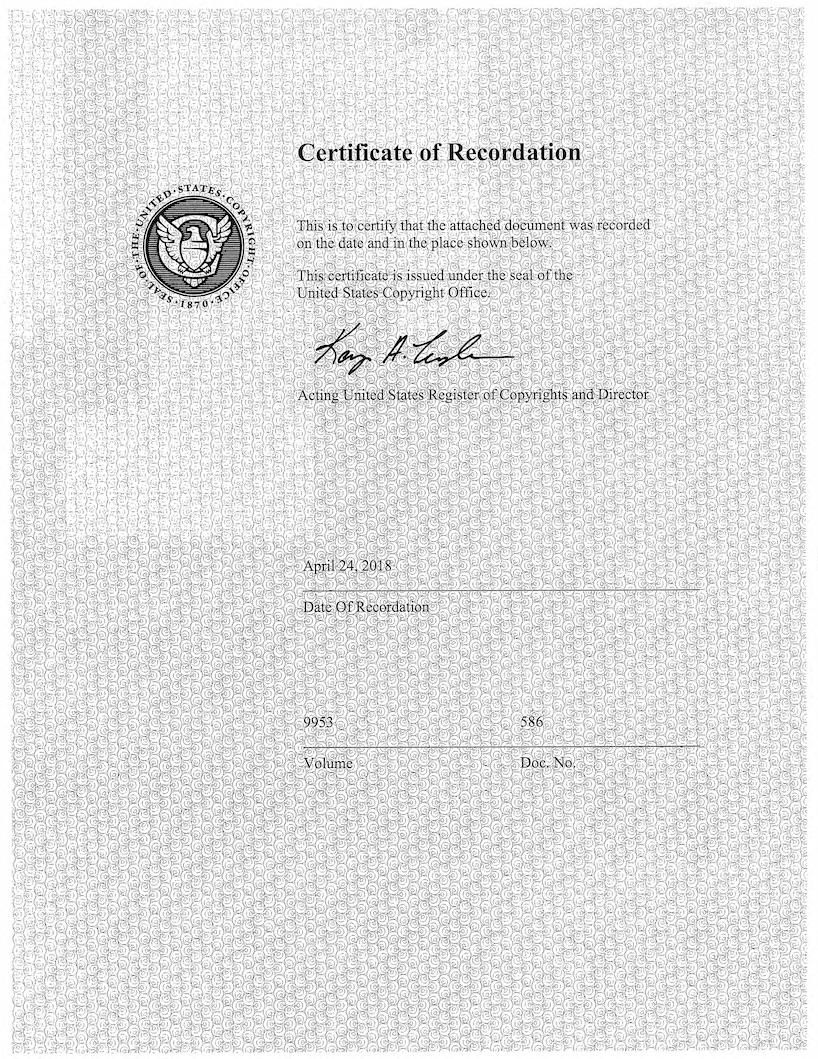
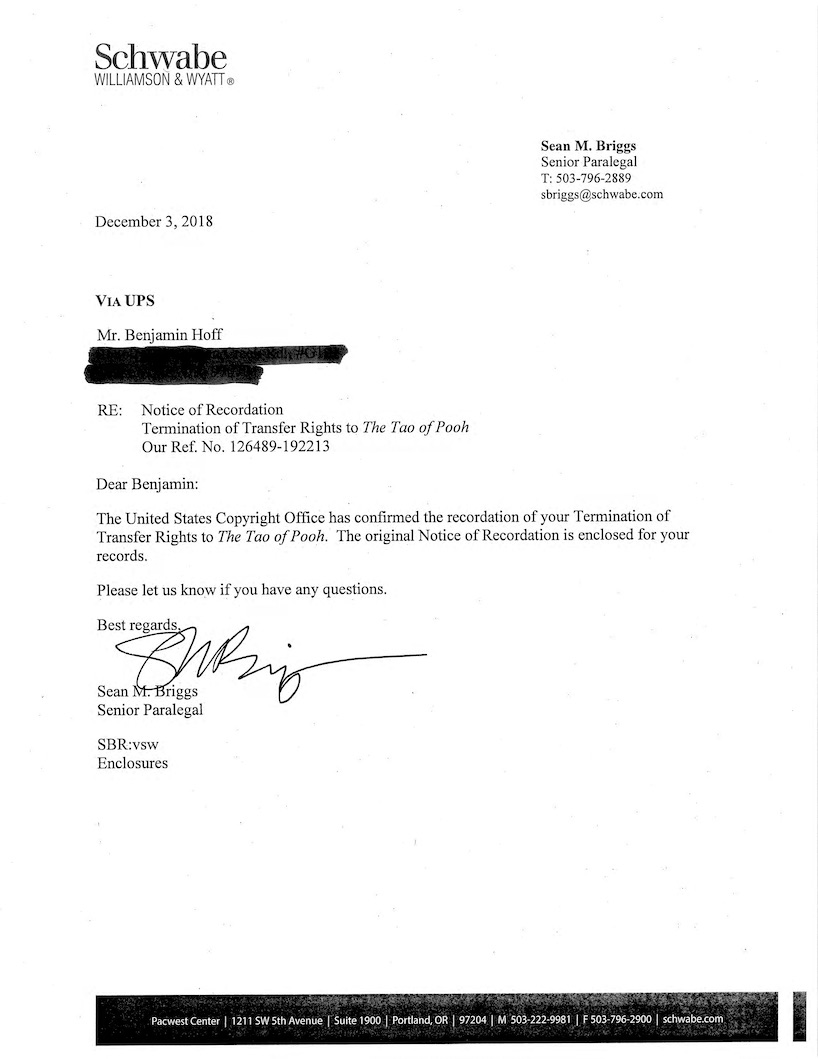
UPDATE: AUGUST 14, 2019
As of December 15, 2019, Penguin is no longer the owner of the copyright to The Tao of Pooh. Since that date, all sales of new editions of the book by Penguin or Dutton in the U.S and its territories and possessions have been in violation of U.S. copyright law.
Penguin has never owned e-book rights to The Tao of Pooh. Therefore all permissions that Penguin may have granted to others to publish e-book editions of the book -- including the Kindle and various library editions -- have been granted illegally. None of the publishers of the e-book editions of The Tao of Pooh listed on the Internet have asked for my permission to publish. They all have taken my permission without asking. All of these e-books are illegal.

ARTICLES, ESSAYS, AND MORE BY BENJAMIN HOFF
- In the late 1960s, Benjamin Hoff helped to form United Travel Service, a unique-sounding rock/pop band. Click here for a link to utsrocks.com, for info on the band and their LP & CD releases.